
DHI Micrograft hair transplant
This is our standard DHI hair transplant in Bangkok, and the one we perform most. We fully shave the donor area at the back of your head, which gives us the most donor area to harvest grafts. That makes it a great choice when you need a larger number of grafts to cover a receding hairline, the crown or a wider bald area.
Grafts are extracted one at a time using FUE (Follicular Unit Excision), trimmed under a microscope, then placed into pre-made incisions with the Lion Implanter.
- Over 2,000 grafts, up to 3,500 per case
- 4 to 8 hours, about 5 for 2,000 grafts
- Fly home from day 3
- Package price by graft count
Is Shaven DHI Micrograft right for you?
It suits you if:
- You need more than about 2,000 grafts, for example the hairline plus the mid-scalp or crown
- You don't mind having short hair at the back for a few weeks
- You'd like the simplest aftercare, since a short donor area is easy to keep clean
- Your hair loss has slowed, and you have enough donor hair, which your doctor will confirm
It isn't for you if:
- You need fewer grafts and want to keep your hairstyle. Partial Shave or Long Hair DHI may suit you better.
- Your hair loss is still progressing fast, especially at a young age. Medication or other treatment usually comes first.
- You have an uncontrolled medical condition or a scalp disorder. That needs treating before surgery.
We check all of this at your consultation, and we'll tell you honestly if a transplant isn't right for you yet.
Shaven, Partial Shave or Long Hair DHI?
All three are DHI Micrograft: grafts are extracted one at a time (FUE), then placed into pre-made incisions with the Lion Implanter. The difference is how we manage the donor area at the back, and that decides how many grafts we can take.
| Shaven DHI Micrograft | Partial Shave DHI | Long Hair DHI | |
|---|---|---|---|
| Donor area | Fully shaved | Small patches trimmed, the rest left long | Not shaved or trimmed |
| Grafts per case | Over 2,000, up to 3,500 | Up to 2,000 | Usually up to 2,000 |
| Usually used for | Larger areas, such as hairline plus mid-scalp or crown | Hairline, temples or a smaller area | Smaller cases where nothing can look different |
| Surgery time | 4 to 8 hours (typically about 5 hours for 2,000 grafts) | Slightly longer for the same number of grafts | Longest for the same number of grafts |
| Aftercare | Simplest, because the short donor area is easy to keep clean | Needs more care around the long hair | Needs the most care |
| Price | Package price by graft count | Package price by graft count | Package price by graft count |
| Recipient area | Not always shaved, especially for smaller hairline cases. Decided with your doctor at your pre-op consultation. | Same | Same |
If you're not sure which fits, send us photos of your hairline, crown and the back of your head. A doctor will tell you which options are realistic for you.
On the day
Your pre-op consultation takes place the day before surgery. Your doctor carries out a full assessment, confirms your graft count, agrees with you whether the recipient area should be shaved or trimmed, and gives you your medications and instructions. On the day itself:
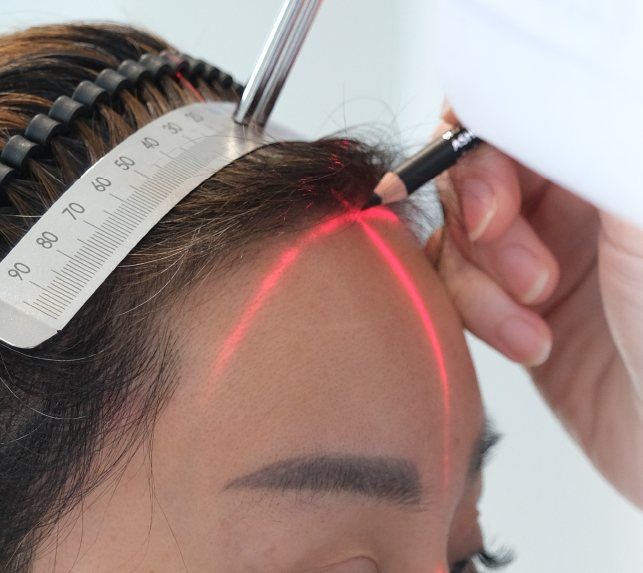
Hairline and area design.
Your doctor draws the plan on your scalp with you and agrees the final graft count and price before anything starts.
Shaving the donor area.
We shave the back and sides short, so every usable graft can be reached.
Local anaesthetic.
Light sedation, gentle vibration and a massage come as standard, to make the anaesthetic injections easier.
Extraction.
Your doctor removes each graft individually with a small motorised FUE punch.
Micrografting.
Grafts are counted and trimmed under a microscope, then stored at 2 to 4°C in a holding solution.
Pre-made incisions.
Your doctor makes the small incisions that set the angle, direction and depth of every hair follicle.
Implantation.
Our trained clinical team places each graft with the Lion Implanter while your doctor oversees. Grafts go back in the order they came out.
Finishing.
We rinse the area with saline and dress the donor area.
About 2,000 grafts takes around 5 hours. Larger cases take longer, up to about 8 hours. You'll have breaks, including lunch.
Recovery and results
| When | What to expect |
|---|---|
| First few days | Some tightness or soreness. We wash your hair at the clinic for up to 6 days. Most people can fly home from day 3. |
| Days 3 to 7 | Swelling reaches its peak, then eases off, sometimes spreading to the forehead or around the eyes first. Mild aches or headaches, some redness over the treated area, and a tender, sensitive scalp are all part of normal healing. |
| Days 7 to 14 | Small scabs form around each graft and gradually fall away. Some numbness at the top of the scalp is common, and it fades over the following weeks. |
| Weeks 3 to 4 | The transplanted hairs shed. This is normal, and the roots stay in place. |
| Months 3 to 4 | New growth starts, with thin, wispy hairs in the recipient area. |
| Month 6 | Noticeably thicker hair, typically around 40 to 60% of the final result. |
| Around 12 months | You see the final result. |
The shaved donor area grows back at the normal rate of hair, roughly 1 cm a month. Within a few weeks it looks like a short haircut.
We stay with you throughout your first year, with check-ins at 2 weeks and at 1, 3, 6, 9 and 12 months, in person or by video call.
If your result doesn't meet our standard at 10 to 12 months, we offer a revision free of charge, as long as you've followed your aftercare and kept in touch.
Patient results
Our own patients, treated and photographed at our clinic with their consent. Every result depends on the patient's own hair and donor area.
Price
Shaven DHI Micrograft is priced by graft count, so a larger area is more costly than a smaller one.
Send us photos and we'll give you an estimate. Your doctor measures again at your pre-op consultation and confirms the final price with you before we start. If you'd prefer a lower price, we can treat a specific area or plan a variable density.
Every package includes:
- A free online consultation with a doctor and an in-person pre-operative consultation
- Your medications for six months
- A take-home aftercare kit: shampoo, moisturiser, saline spray and dressings
- Hair washing at the clinic for up to 6 days after surgery
- Yellow laser sessions to help swelling settle
- LLLT sessions at the clinic for up to a year
- Follow-up reviews for a year, in person or by video call
- A free revision if your result doesn't meet our standard at 10 to 12 months, as long as you've followed your aftercare and kept in touch
For your estimate, book a free online consultation.
How DHI Micrograft works
DHI Micrograft and FUE
DHI Micrograft is a variant of FUE (follicular unit extraction). Hair at the back and sides of the head naturally resists DHT, the hormone behind pattern hair loss, and it keeps that resistance after it's moved.
We extract it one graft at a time with a 0.7 to 0.85 mm punch, each graft a natural group of one to four hairs, and move it to where it's needed.
Where DHI Micrograft differs from standard FUE is in how the grafts go in. Your doctor makes every incision first, at the angle, direction and depth the hair should grow. Then each graft is loaded into a Lion Implanter, a pen-like tool from South Korea, and placed into its incision. The graft is handled less, and every hair follows the plan.
Why we shave the donor area
A shaved donor area lets your doctor see every follicle and choose grafts evenly from across the whole back and sides, instead of only from small trimmed patches.
That's what makes 3,500 grafts possible in one case, while taking few enough from any one spot that the donor area still looks natural afterwards. It's also the quickest variant, and the short hair makes the donor area easy to clean while it heals.
Ask us if you'd like an example of how it will look.
Micrografting
Each graft is counted and trimmed under a microscope to remove the tissue it doesn't need to survive.
Smaller grafts fit into smaller incisions, so they can sit closer together. That gives more density per square centimetre, and the scalp heals smoother.
Does the area being treated need to be shaved?
Not always. Smaller cases at the hairline can often be done between your existing hairs. In larger cases, your doctor may advise shaving it. You'll decide together at your pre-op consultation.
How dense will it be?
We usually plan 40 to 50 grafts per cm² at the hairline, and 30 to 40 for the mid-scalp, the crown and areas that still have thinning hair. We plan fewer if your existing hair is still in good condition. Everything is adjusted to what your donor area can safely supply, including what you may need later.
Which level of hair loss can DHI Micrograft treat?
We use the Norwood scale, the standard way of grading male pattern hair loss, alongside an assessment of your donor area and how your hair loss is likely to progress.
Levels 2 to 4.
A receding hairline, temple gaps or early thinning at the crown. This is where a transplant usually gives the clearest result, and where we can rebuild the hairline while keeping donor hair in reserve for later.
Levels 5 to 6.
A larger area. A transplant is still possible, but it needs a closer look at how many grafts your donor area can give. We may suggest focusing density on the hairline and mid-scalp, where it makes the most visible difference, or a staged plan with 2 sessions.
Level 7.
Most of the top of the scalp has receded. Donor supply is the main limit. We prioritise the areas in the midscalp, so the grafts you have give the most natural result. Full density over the whole scalp usually isn't realistic, and we'll let you know what you can expect from the procedure.
Female pattern hair loss (Ludwig scale).
For women, we use the Ludwig scale, which grades thinning across the top of the head while the front hairline usually stays in place. A transplant can help when the thinning is stable, concentrated in one area, and the donor area at the back is strong. When thinning is spread evenly across the scalp, including the back, non-surgical treatment such as GFC is usually the better first step. Most women will choose the Partial Shave so they can keep their hairstyle.
Before your surgery
We'll send you the full pre-op guide when you book. The main points:
- Tell us about every medication, supplement and allergy. Don't stop any prescribed medication without checking with us first.
- Avoid alcohol and fermented foods for a week before.
- Stop or cut down smoking for 2 weeks before. Nicotine narrows blood vessels and reduces blood supply to the grafts.
- Don't colour or perm your hair for a month before.
- Wash your hair on the morning of surgery.
- Sleep well the night before, and drink plenty of water. Avoid coffee, tea and fizzy drinks on the day.
- Wear a button-up shirt, so nothing has to go over your head afterwards.
Blood test. We need a recent blood test for HIV, hepatitis B and C, and syphilis before surgery. You can bring results from your own provider or have it done at the clinic.
After your surgery
We'll give you the full aftercare guide on the day. The main points:
- Take your medication as prescribed.
- Wear the headband for at least 4 days to keep swelling off your face.
- Sleep on your back with your head raised.
- Don't touch, scratch or rub the treated area for 2 weeks.
- Don't bend your head below your waist for a week.
- No alcohol, smoking or sex for at least a week.
- No exercise or heavy sweating for 2 weeks. Walking is fine.
- No swimming pools, saunas or steam rooms for a month.
- Keep out of strong sun for 2 to 4 weeks, and only wear loose headwear we've approved.
- No haircuts, colouring or chemical treatments on the treated area for a month.
- No gels, waxes or sprays until we say the scalp has healed.
Normal healing
These potential side effects of hair transplant are part of normal healing and settle on their own:
- Swelling around the forehead or eyes, settling in 3 to 7 days
- Tightness, soreness, itching or numbness. Tightness, soreness and itching usually ease within 1 to 2 weeks. Numbness can take a few weeks to a few months to settle fully
- Redness and small scabs along the treated area, which fall off over 7 to 14 days. Don't pick them.
- Shedding of transplanted hairs at 3 to 4 weeks. Nearby existing hair can also shed for a while (shock loss). It grows back.
Contact us straight away if you have severe pain, swelling that keeps getting worse, or unusual discharge.
Why Bangkok Hair Clinic for DHI Micrograft
The same team looks after you from your first photos to your 12-month review, ensuring a seamless experience throughout.
- Your doctor does the surgical work. Our doctors harvest the grafts and make the incisions themselves, and oversee every graft as it's placed.
- Planned for the long term. We plan larger cases around how your hair loss is likely to progress, and keep donor hair in reserve where we can.
- Graft care built into the process. Every graft is trimmed under a microscope, stored at 2 to 4°C and placed first-out, first-in.
- Natural hairline design. Drawn with the small irregularities real hair grows in, never a straight, even edge.
DHI Micrograft questions
DHI Micrograft is a type of FUE. The grafts are extracted the same way, one at a time. The difference is placement: your doctor makes the incisions first, then each graft is placed with a Lion Implanter, which gives more control over angle, direction and depth.
For Shaven DHI Micrograft, the donor area at the back and sides is shaved. The area being treated isn't always shaved, especially for smaller hairline cases. Your doctor will decide with you at your pre-op consultation. If you need fewer than about 2,000 grafts, Partial Shave or Long Hair DHI may let you avoid shaving altogether.
Hair grows roughly 1 cm a month, so within a few weeks the back looks like a short haircut.
Up to 3,500 per case, depending on how much your donor area can safely give.
Between 4 and 8 hours, depending on the size of the area. About 2,000 grafts takes around 5 hours.
The anaesthetic injections sting at first. Light sedation, gentle vibration and a massage are standard to help. After that, most people feel pressure rather than pain. Painkillers are part of your medication afterwards.
Yes. No hair transplant is scar-free. Our 0.7 to 0.85 mm punches leave small dot scars under a millimetre, spread across the donor area, with no line scar, and surrounding hair usually covers them once it grows back. If you plan to keep your hair very short, tell us at consultation.
We expect at least 90 to 95% of grafts to survive. Each graft is trimmed under a microscope, stored at 2 to 4°C in a holding solution, handled as little as possible, and placed in the order it was removed. How well grafts take also depends on your scalp and on following your aftercare.
Complications are uncommon, but as with any surgery they can happen. They include infection, folliculitis (inflamed follicles that look like small spots), lower than expected graft survival, overharvesting of the donor area, more noticeable scarring, and numbness that lasts longer than usual. Sterile technique, careful planning of the donor area and a year of follow-up all help keep these risks low. Your doctor explains them before surgery.
The hairs shed at around 3 to 4 weeks. That's expected. The roots stay in place, and new growth starts at 3 to 4 months.
Transplanted hair usually keeps growing for life, because it comes from an area that resists pattern hair loss. Your untreated hair can keep thinning, which is why we often recommend medication, GFC or LLLT alongside a transplant.
Medication, GFC and laser therapy can help slow ongoing hair loss. If you need more coverage later, a second transplant may be possible, depending on your donor area. If you've had a previous transplant, let us know.
Yes. Many women prefer Partial Shave so they can keep their hairstyle, and Shaven is there when more grafts are needed. We treat female hair loss with medication, GFC, laser treatments or a hair transplant. Female hair loss is more complex than male pattern hair loss, so speak to a doctor about which options suit you.
In packages by graft count. Every package includes your medications, aftercare, laser sessions and a year of follow-up. For your estimate, book a free online consultation.
Ask about your case
Send us photos of your hairline, crown and the back of your head. A doctor will look at them and tell you which variant suits you, roughly how many grafts you'd need, and give you a price estimate. Online consultations are free.