
Low-Level Laser Therapy (LLLT)
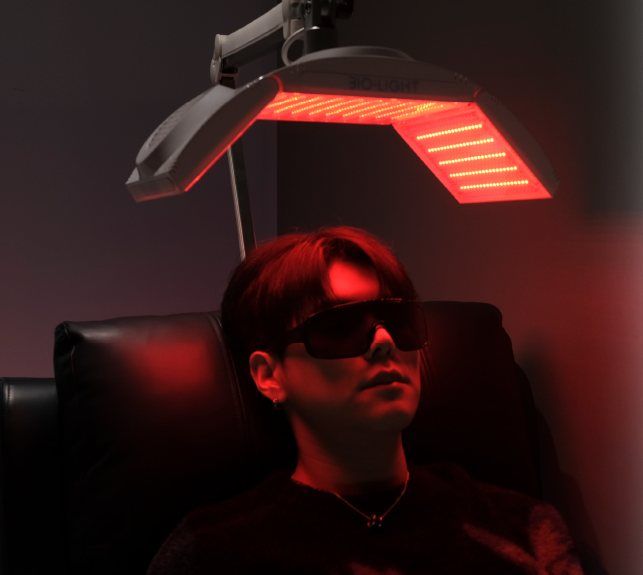
Low-Level Laser Therapy (LLLT) is a laser hair loss treatment in Bangkok that uses low-power laser light at a wavelength of 650 nanometres (nm), which the eye sees as red, on the scalp for 15 to 20 minutes. No surgery, no needles. It works on the hair follicles you still have, encouraging follicles in the resting phase (telogen) to return to the growth phase (anagen), so hairs keep growing for longer and look thicker.
We use LLLT as an adjunctive treatment, alongside GFC, Cell Plus Therapy or a hair transplant, not as a replacement for them. There's research behind it: trials show it can increase hair density in pattern hair loss, including a study in Thai patients [1] [2].
- Non-surgical, no needles
- 15 to 20 minutes per session
- In clinic every 2 weeks, with a home device in between
- Usually part of a GFC, CPT or transplant course
Is LLLT right for you?
It suits you if:
- Your hair is thinning, but the area still has hair, for example at the crown, the parting or across the top
- You've had a hair transplant and want to support healing and the hair around it
- You'd like a treatment without needles, alongside or instead of medication
- You're a man or woman with pattern hair loss at an early to moderate stage
It isn't for you if:
- The area is already bald. LLLT works on follicles that are still alive, so a transplant is the option there.
- You have a light-sensitive condition, or take medication that makes your skin sensitive to light. Your doctor will check this first.
We check all of this at your consultation. If LLLT on its own isn't likely to be enough, we'll tell you, and explain what to pair it with.
Compare treatments for thinning hair
All four work on hair that's thinning but still growing. They're often combined.
| GFC | Cell Plus Therapy (CPT) | LLLT | LPT | |
|---|---|---|---|---|
| What it is | Growth factors from your own blood, injected into the scalp | A small sample of your own scalp, processed and injected | Low-level laser light on the scalp | Thulium laser followed by a peptide serum |
| Sessions | 3 to 5, 4 to 6 weeks apart, then maintenance | One treatment, often repeated every 1 to 2 years | Every 2 weeks in clinic, with a home device in between | Every 2 weeks |
| Time per session | 30 to 45 minutes | About 1 to 1.5 hours | 15 to 20 minutes | About 30 minutes |
| Best for | Early to moderate thinning, men and women | Thinning areas where follicles remain | Everyone with thinning hair, often alongside other treatment | People based in Thailand |
If you're not sure which fits, send us photos of your hairline, crown and parting. A doctor will tell you which options are realistic for you.
What happens at a session
Scalp check
At your first visit, your doctor looks at the thinning areas and takes baseline photos to track progress.
Positioning
You sit comfortably under the laser panel, with protective eyewear.
Treatment
Red laser light from our Biolight device shines on the scalp for 15 to 20 minutes. Most people feel nothing, or a slight warmth.
Done
No recovery time. You can go straight back to work or the gym.
We usually recommend a session at the clinic every 2 weeks, with a home device on the days in between. Your doctor will suggest a device and show you how to use it.
Results
LLLT works with the hair growth cycle, so results take months. They vary from person to person.
| When | What to expect |
|---|---|
| First 1 to 2 months | Some people shed a little more for a few weeks as resting hairs make way for new growth. This is temporary. |
| Months 3 to 4 | Less shedding, and hair that starts to feel thicker. |
| Around 6 months | The clearest change, usually in density and the thickness of each hair. In a 24-week Thai trial, the laser group gained significantly more density (p = 0.002) and thicker hairs (p = 0.009) than the placebo group [1]. |
| After that | Regular sessions help keep the result. If you stop, the benefit fades gradually. |
Your doctor reviews your progress against your baseline photos and adjusts the plan if needed.
Price
LLLT is priced as a package. We see it as an adjunctive treatment, so it's routinely included as part of GFC, Cell Plus Therapy and hair transplant courses: for up to a year after a transplant, and for 6 months with Cell Plus Therapy. Ask us about the package price at your free online consultation.
For prices, book a free online consultation.
How LLLT works
Light as energy for the follicle
The scientific name is photobiomodulation. Red light at low power reaches the follicle and is absorbed by its mitochondria, the part of each cell that makes energy. The cell then produces more ATP, its energy supply, and blood flow around the follicle improves. Follicles that had slipped into a resting phase are nudged back into the growth phase (anagen), and existing hairs tend to grow thicker.
Why low-level
"Low-level" means the light is too weak to heat or cut tissue. That's the difference from the lasers used for hair removal or resurfacing. It doesn't burn, and it doesn't damage the follicle.
Why we suggest a home device too
Most trials used devices several times a week. A session at the clinic every 2 weeks gives your doctor a regular check and a stronger dose, and a home device keeps the follicles topped up in between. Together they come much closer to what the research tested.
What the research shows
LLLT is one of the better-studied hair loss treatments outside medication and surgery. A few of the key papers:
In Thai patients.
A 24-week, randomised, double-blind trial at Ramathibodi Hospital, Mahidol University, treated 40 Thai men and women with pattern hair loss, using a home-use laser helmet. The laser group gained significantly more hair density (p = 0.002) and thicker hairs (p = 0.009) than the placebo group. The only side effects were temporary shedding and a mild itch. The authors note it was a small study without long-term follow-up [1].
Across 38 studies.
A systematic review and meta-analysis of 3,098 patients, 2,930 of them with pattern hair loss, found hair density in pattern hair loss rose significantly with LLLT compared with placebo, both under 20 weeks of use (standardised mean difference 1.14) and over 20 weeks (1.44) [2].
In 11 double-blind trials, across 8 studies.
A meta-analysis of 11 double-blind randomised trials found a significant increase in hair density with LLLT over sham devices (standardised mean difference 1.32), in men and women, with both comb and helmet devices. Lower-frequency schedules showed a larger effect (1.56) than higher-frequency ones (0.95) [3].
Alongside other treatment.
A review of 13 clinical trials found significant improvement with LLLT in 10 of 11 trials analysed, benefit in two trials that combined it with topical minoxidil, and in one alongside finasteride [4].
What the research doesn't show: that LLLT regrows hair on bald skin, or that it works the same for everyone. Results vary, which is why we track yours with photos.
Before your session
- Wash your hair beforehand, and don't use gel, wax or oil on the day. Product blocks the light.
- Tell us about any medication or condition that makes your skin sensitive to light.
After your session
Nothing special. You can wash, style and exercise as normal.
Normal healing
LLLT is very well tolerated. The trials reported only mild, short-lived side effects:
- Temporary shedding in the first few weeks, as resting hairs make way for new growth
- A mild itch or warmth on the scalp
Tell us if your scalp becomes red or irritated, and we'll adjust your sessions.
Why Bangkok Hair Clinic for LLLT
Effective treatment for thinning hair starts with an accurate diagnosis and continuous follow-up. At Bangkok Hair Clinic, a doctor looks after you from your first consultation to the end of your treatment.
Part of a doctor's plan.
LLLT works best alongside other treatment. Your doctor decides what to pair it with, from medication to GFC or a transplant.
Progress you can see.
We take baseline photos and compare them at your reviews, so you know whether it's working.
Clinic and home, together.
Sessions every 2 weeks at the clinic, plus advice on a home device, to match what the research tested.
Included with your treatment course.
LLLT is built into our GFC, Cell Plus Therapy and transplant courses, because it works best as an adjunct.
Honest about the limits.
LLLT supports hair that's still growing. If an area is already bald, we'll tell you.
LLLT questions
For pattern hair loss in men and women, randomised trials against placebo devices show a significant increase in hair density. A review of 38 studies and 3,098 patients confirmed this [2], and a 24-week trial in 40 Thai patients found significantly more density and thicker hairs than placebo [1]. It works best on hair that's thinning, not on bald areas, and results vary.
No. Most people feel nothing, or a slight warmth.
We recommend a session at the clinic every 2 weeks, with a home device in between. Your doctor will set a plan for your hair.
Usually from 3 to 4 months, with the clearest change at around 6 months.
They're mild and uncommon: temporary shedding in the first weeks, and occasionally a mild itch. These were the only side effects reported in the Thai trial [1].
Yes, and it's often recommended. Trials have shown benefit when LLLT is combined with topical minoxidil [4], and we routinely pair it with GFC, Cell Plus Therapy or a hair transplant.
Many people use it after a transplant to support healing and the hair around the grafts. It's included for up to a year in our transplant packages.
Yes. The trials included women, and LLLT is often part of the plan for female hair loss, along with medication, GFC or, in some cases, a transplant. Female hair loss is more complex, so speak to a doctor about your options.
No. It works on follicles that are still alive.
It helps, because the research used frequent sessions. Your doctor can advise which type suits you and how often to use it.
The benefit fades gradually, which is why we suggest keeping up regular sessions.
As a package. It's routinely included in GFC, Cell Plus Therapy and hair transplant courses, because we use it as an adjunctive treatment.
Ask if LLLT suits you
Send us photos of your hairline, crown and parting. A doctor will look at them and tell you whether LLLT is likely to help, what to pair it with, and the price. Online consultations are free.
References
- Suchonwanit P, Chalermroj N, Khunkhet S. Low-level laser therapy for the treatment of androgenetic alopecia in Thai men and women: a 24-week, randomized, double-blind, sham device-controlled trial. Lasers Med Sci. 2019;34(6):1107–1114. doi:10.1007/s10103-018-02699-9. PMID: 30569416. doi.org/10.1007/s10103-018-02699-9
- Perez SM, Vattigunta M, Kelly C, Eber A. Low-level laser and LED therapy in alopecia: a systematic review and meta-analysis. Dermatol Surg. 2025;51(2):179–183. doi:10.1097/DSS.0000000000004442. PMID: 39404126. doi.org/10.1097/DSS.0000000000004442
- Liu KH, Liu D, Chen YT, Chin SY. Comparative effectiveness of low-level laser therapy for adult androgenic alopecia: a system review and meta-analysis of randomized controlled trials. Lasers Med Sci. 2019;34(6):1063–1069. doi:10.1007/s10103-019-02723-6. PMID: 30706177. doi.org/10.1007/s10103-019-02723-6
- Darwin E, Heyes A, Hirt PA, Wikramanayake TC, Jimenez JJ. Low-level laser therapy for the treatment of androgenic alopecia: a review. Lasers Med Sci. 2018;33(2):425–434. doi:10.1007/s10103-017-2385-5. PMID: 29270707. doi.org/10.1007/s10103-017-2385-5
All references checked against PubMed, 14 October 2026.