
Laser Peptide Therapy (LPT)
Laser Peptide Therapy (LPT) is a thulium laser hair loss treatment in Bangkok, done in two steps. First, a fractional thulium laser at a wavelength of 1,927 nanometres (nm) makes a fine grid of microscopic channels in the upper layer of the scalp. Then we apply a peptide serum, which can pass through those channels instead of sitting on the surface. No surgery, no needles. It works on the follicles you still have: ones that have miniaturised and now grow finer, weaker hairs.
There's growing evidence behind thulium lasers for pattern hair loss. In a split-scalp trial, the laser on its own increased hair density and thickness, and adding a growth-factor solution after it did better still [1]. A 2026 review of 37 studies found fractional lasers gave the biggest gains when paired with a treatment applied to the scalp [4].
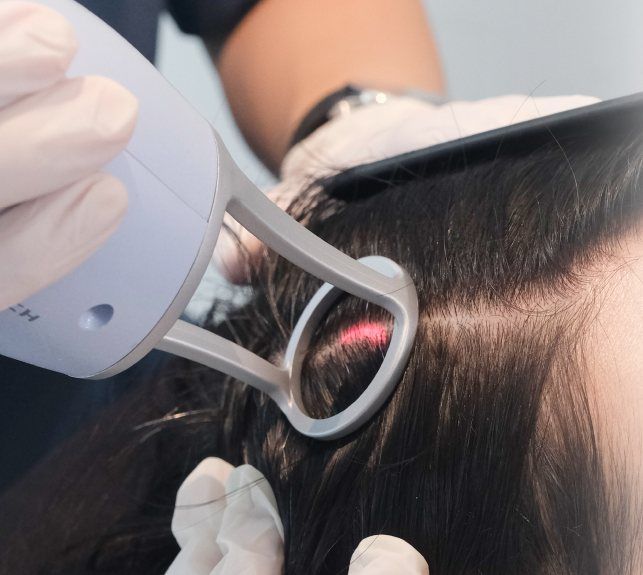
- Non-surgical, no needles
- About 30 minutes per session
- Every 2 weeks, with changes usually noticeable after about 6 sessions
- No numbing needed for most people
Is LPT right for you?
It suits you if:
- Your hair is thinning, but the area still has hair, for example at the crown, the parting or across the top
- You're a man or woman with pattern hair loss at an early to moderate stage
- You'd like a treatment without injections
- You want to add to treatment you're already on, such as medication, GFC or LLLT
- You live in or near Bangkok and can come in every 2 weeks
It isn't for you if:
- The area is already bald. LPT works on follicles that are still alive, so a transplant is the option there.
- Your scalp has an infection, a wound or a flare of a skin condition. We treat that first.
- You're in Bangkok for a short trip. LPT is a course of sessions, 2 weeks apart.
We check all of this at your consultation. If LPT on its own isn't likely to be enough, we'll tell you, and explain what to pair it with.
Compare treatments for thinning hair
All four work on hair that's thinning but still growing. They're often combined.
| GFC | Cell Plus Therapy (CPT) | LLLT | LPT | |
|---|---|---|---|---|
| What it is | Growth factors from your own blood, injected into the scalp | A small sample of your own scalp, processed and injected | Low-level laser light on the scalp | Thulium laser followed by a peptide serum |
| Sessions | 3 to 5, 4 to 6 weeks apart, then maintenance | One treatment, often repeated every 1 to 2 years | Every 2 weeks in clinic, with a home device in between | Every 2 weeks |
| Time per session | 30 to 45 minutes | About 1 to 1.5 hours | 15 to 20 minutes | About 30 minutes |
| Best for | Early to moderate thinning, men and women | Thinning areas where follicles remain | Everyone with thinning hair, often alongside other treatment | People based in Thailand |
If you're not sure which fits, send us photos of your hairline, crown and parting. A doctor will tell you which options are realistic for you.
What happens at a session
Scalp check.
At your first visit, your doctor looks at the thinning areas and takes baseline photos to track progress.
Cleanse.
We clean the scalp and part the hair so the laser reaches the skin.
Thulium laser.
The laser passes over the thinning areas. Most people feel warmth or a light prickling. We don't numb the scalp as routine, but we can apply numbing cream if you'd like it.
Peptide serum.
We apply the serum straight after the laser, while the channels are fresh.
Done.
About 30 minutes in total. Your scalp may look pink for a day or two, but you can go straight back to work.
We recommend a session every 2 weeks. Most people start to notice a change after about 6 sessions, so roughly 3 months in.
Results
LPT works with the hair growth cycle, so results take months. They vary from person to person.
| When | What to expect |
|---|---|
| After each session | Pinkness or warmth on the scalp for 1 to 2 days. Your hair looks the same. |
| Around 6 sessions (about 3 months) | The first changes most people notice: hair that feels thicker and looks fuller at the parting or crown. |
| Around 6 months | A clearer change in density and in the thickness of each hair. In a Thai study of thulium laser with PRP, terminal hair density rose by 28.1% six months after the last session [2]. |
| After that | Your doctor compares your photos with your baseline and suggests how often to keep going. |
Your doctor tracks your progress against your baseline photos and adjusts your plan as needed.
Price
LPT is priced per session, and as a course package. Ask us about both at your free online consultation.
For prices, book a free online consultation.
How LPT works
The laser: 1,927 nm thulium
The laser is fractional, which means it treats a grid of tiny columns and leaves the skin between them untouched. It's also non-ablative: it heats those columns without stripping away the surface, so the scalp recovers in a day or two rather than a week. Under the microscope, each column shows up as a small zone of heated tissue with no open wound [1]. The micro-injury is thought to set off the scalp's own repair response, and the follicles sit right in the middle of it.
The serum
Most of what you put on intact skin stays on the surface. That's the point of the channels. In lab tests on human skin, pretreatment with a 1,927 nm thulium laser increased how much of a topical the skin took up and held on to [3]. So we apply a peptide serum for the scalp straight after the laser, while the channels are fresh.
Why the two together
The laser does two jobs: it prompts repair, and it opens the way in. The serum uses the second. Across studies, fractional lasers have done better when paired with something applied afterwards than on their own [4].
What the research shows
Thulium lasers for hair are newer than LLLT, and most studies are small. The evidence is growing, though, and it points the same way. The key papers:
- Thulium alone, and with a solution after. An evaluator-blinded, split-scalp trial in Korea gave 10 people with pattern hair loss 12 weekly thulium sessions. The laser on its own significantly increased hair density and thickness. Applying a growth-factor solution after the laser added a further improvement on that side of the scalp [1].
- In Thai men. A pilot study at Chulalongkorn University treated 9 men with three thulium sessions, a month apart, each followed by PRP injections. Six months after the last session, terminal hair density had risen 28.1% (from 99.1 to 127 hairs per cm², p = 0.011), total density 9.7% (p = 0.015) and hair mass index 26.4% (p = 0.024). The men rated the laser 0.8 out of 10 for pain. There was no control group, and the PRP was injected rather than applied as a serum [2].
- Helping topicals into the skin. In donor human skin, a 1,927 nm thulium laser increased the uptake and retention of a topical applied afterwards, compared with untreated skin [3].
- Across 37 studies. A 2026 systematic review and meta-analysis of 3,298 patients found fractional lasers effective and safe for pattern hair loss. Combined with minoxidil, PRP or growth factors, they raised density by a mean of 33.6 hairs per cm², and clinicians rated more patients as improved than with laser alone (95.3% vs 77.2%) [4].
- Every 2 weeks, without numbing. In 10 Indonesian patients, two thulium sessions two weeks apart, done without anaesthesia, significantly improved photographic scores and satisfaction. Pain was minimal, and there were no treatment-related side effects [5].
What the research doesn't show yet: a pooled analysis of 14 fractional laser studies found thulium improved hair thickness but not hair counts [6]. No published trial has tested our exact laser and serum together, and follow-up in most studies is short. Results vary, which is why we track yours with photos.
Before your session
- Wash your hair the night before or that morning, and don't use gel, wax or oil on the day.
- Tell us about any scalp condition, or if your scalp is sunburnt.
- If you'd like numbing cream, mention it when you book so we can put it on ahead of time.
After your session
- Wait about 24 hours before washing your hair. After that, wash gently with a mild shampoo.
- Keep your scalp out of strong sun while it's pink, and wear a hat if you're outdoors.
You can go back to work the same day.
Normal healing
Most people have only mild, short-lived effects:
- Pinkness or warmth on the scalp for about 1 to 2 days
- A mild burning feeling for a short while after the session
Tell us if the redness lasts longer than a few days, or if you see blistering or crusting, and we'll check it.
Why Bangkok Hair Clinic for LPT
Treating thinning hair effectively starts with the right diagnosis and continued follow-up. At Bangkok Hair Clinic, a doctor looks after you from your first consultation to the end of your treatment.
- Part of a doctor's plan. Your doctor decides whether LPT suits you and what to pair it with, from medication to GFC, LLLT or a transplant.
- Progress you can see. We take baseline photos and compare them at your reviews, so you know whether it's working.
- Straight answers on the evidence. We'll tell you what the studies show, and what they don't yet.
- Honest about the limits. LPT supports hair that's still growing. If an area is already bald, we'll tell you.
LPT questions
A fractional laser at 1,927 nm that makes microscopic heated columns in the upper layer of the scalp. It's thought to prompt the scalp's repair response, and it helps a serum applied afterwards get into the skin.
The evidence is growing. Trials show thulium increases hair density and thickness in pattern hair loss, especially when combined with a treatment applied afterwards [1] [4]. Most studies are small, results vary, and it doesn't regrow hair on bald areas.
Most people feel warmth or a light prickling. In a Thai study, men rated the laser 0.8 out of 10 for pain [2]. We don't numb as routine, but numbing cream is available if you'd like it.
We recommend a session every 2 weeks. Most people notice a change after about 6 sessions. Your doctor will set a plan for your hair.
Not really. Your scalp may be pink or warm for 1 to 2 days. Wait about 24 hours before washing your hair.
LLLT uses low-power red light at 650 nm, which reaches the follicle without heating the skin. LPT uses a 1,927 nm infrared thulium laser that makes microscopic heated channels, followed by a peptide serum. They work differently, and can be used together.
Yes. It's often used alongside medication, GFC or LLLT. Your doctor will suggest what fits.
Yes. LPT can be part of the plan for female hair loss, along with medication, GFC, LLLT or, in some cases, a transplant. Female hair loss is more complex, so speak to a doctor about your options.
It works as a course, every 2 weeks, so it suits people who live here. If you're visiting, ask us about options that fit your trip.
Per session, and as a course package. Ask us about both.
Ask if LPT suits you
Send us photos of your hairline, crown and parting. A doctor will look at them and tell you whether LPT is likely to help, what to pair it with, and the price. Online consultations are free.
References
- Cho SB, Goo BL, Zheng Z, Yoo KH, Kang JS, Kim H. Therapeutic efficacy and safety of a 1927-nm fractionated thulium laser on pattern hair loss: an evaluator-blinded, split-scalp study. Lasers Med Sci. 2018;33(4):851–859. doi:10.1007/s10103-018-2437-5. PMID: 29340854. doi.org/10.1007/s10103-018-2437-5
- Brownell N, Panchaprateep R, Glinhom R. Combination of a non-ablative 1,927 nm thulium fiber fractional laser and autologous platelet-rich plasma in treatment of male androgenetic alopecia: a pilot study. Chula Med J. 2019;63(1):13–21. doi:10.14456/clmj.1476.3. doi.org/10.14456/clmj.1476.3
- Wang JV, Friedman PM, Agron S, Konda A, Parker C, Geronemus RG. Enhanced uptake and retention of 0.03% bimatoprost, 0.5% 5-fluorouracil, and 5% minoxidil after 1,550-nm or 1,927-nm nonablative laser pretreatment. Dermatol Surg. 2022;48(9):932–936. doi:10.1097/DSS.0000000000003532. PMID: 36054045. doi.org/10.1097/DSS.0000000000003532
- Alahmadi M, Alghamdi S, Albyali S, Alharbi R, Alanazi D, Altamimi A, et al. Lasers and energy-based devices in the treatment of androgenetic alopecia: a systematic review and meta-analysis. Skin Appendage Disord. Published online 15 May 2026. doi:10.1159/000551411. PMID: 42339398. doi.org/10.1159/000551411
- Wardhani PH, Rahmatika A, Thendria T, Putri Kinasih NC, Sarkowi WK. Application of thulium 1927-nm laser for androgenic alopecia treatment in Indonesian patients. J Lasers Med Sci. 2025;16:e42. doi:10.34172/jlms.2025.42. PMID: 41255734. doi.org/10.34172/jlms.2025.42
- Jedlowski PM, Anthony M. Use of fractionated laser therapy for the treatment of androgenetic alopecia: a systematic review and meta-analysis. Lasers Med Sci. 2023;39(1):4. doi:10.1007/s10103-023-03946-4. PMID: 38087122. doi.org/10.1007/s10103-023-03946-4
References 1 and 3 to 6 checked against PubMed, 15 October 2026. Reference 2 is not indexed in PubMed; checked against the Chulalongkorn Medical Journal's own site.